

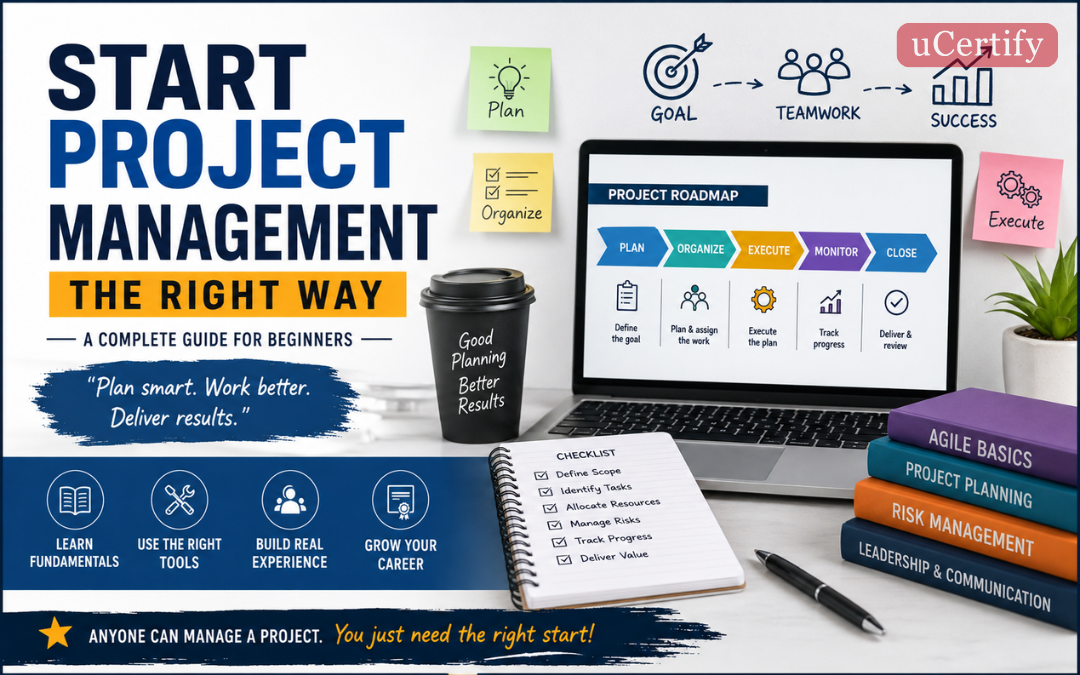
If you want to start project management, the hardest part is often knowing what to learn first. Should you begin with Agile? Do you need a certification? Which project management tools matter? And can you become a project manager if your current job has nothing to do with project management?
You don’t need to answer all of those questions on day one.
Project management becomes much easier to understand when you stop looking at it as a collection of tools, certificates, and complicated terminology. At its core, it is about taking a goal and turning it into organized work that people can actually deliver.
This project management beginner guide will walk you through that process. You’ll learn the fundamentals, the skills that matter, common methodologies, useful tools, ways to gain experience, certification considerations, and a practical 90-day roadmap for getting started.
What You’ll Learn
By the end of this guide, you should be able to explain what project management involves, recognize the main stages of a project, identify the skills a beginner should develop, understand the difference between Agile and Waterfall, choose a tool for practice, and create a realistic plan for gaining your first project experience.
More importantly, you’ll have a clearer idea of what to do next instead of simply collecting information about the profession.
What Is Project Management?
Project management is the structured process of planning and coordinating work to achieve a specific objective within agreed constraints.
Those constraints usually include things such as scope, time, cost, quality, and resources.
Consider a company preparing to launch a new website. The goal might sound simple: launch the website by the end of the quarter. In practice, someone needs to clarify what the website will include, gather requirements, coordinate designers and developers, track deadlines, manage approvals, identify risks, communicate with stakeholders, and deal with changes along the way.
The project manager helps keep those moving parts connected.
That doesn’t mean the project manager personally designs the website, writes its code, or creates every piece of content. Their responsibility is to help the team understand the objective, coordinate the work, remove obstacles, manage expectations, and keep the project moving toward completion.
This distinction is important for beginners. Project management is not the same as doing every task in a project. It is about creating the conditions in which the work can be completed successfully.
Understand the Project Lifecycle First
Before learning complicated frameworks, learn how a project normally moves from an idea to a finished result.
A useful beginner model is:
Define → Plan → Organize → Execute → Monitor → Adapt → Close
During the definition stage, the team establishes what the project is supposed to accomplish. What problem are you solving? What does success look like? What will actually be delivered?
During planning, the larger objective is broken into manageable work. The team considers tasks, timelines, resources, dependencies, risks, and communication.
The organizing stage focuses on responsibilities and coordination. People need to know who owns which task, who needs to approve decisions, and who should receive project updates.
During execution, the planned work gets done. This is where the project manager spends significant time coordinating people, resolving issues, communicating changes, and checking whether work is progressing as expected.
Monitoring happens alongside execution. A project manager compares actual progress with the plan. If a task is late, a budget is increasing, or a requirement has changed, the team needs to understand the effect.
This leads to adaptation. Plans are useful, but they are not promises that reality will follow perfectly. A good project manager adjusts the plan when circumstances change while keeping the project objective in view.
Finally, closure means completing the deliverables, confirming acceptance, documenting important information, and reviewing what the team learned.
You don’t need to memorize these stages. Think of them as a story: What are we trying to accomplish? How will we do it? Who will do what? Are we on track? What changed? Did we finish successfully?
That mindset is more useful than memorizing terminology without understanding it.
The Core Project Management Concepts Every Beginner Should Know
Some project management terms appear everywhere. Learning what they actually mean will make the rest of your studies much easier.
Scope
Scope defines what the project will and will not deliver.
Suppose you’re managing a website redesign. If the agreed project includes five pages, a contact form, and a mobile-friendly layout, those are part of the scope. If someone later asks for an online payment system, that may be a new requirement rather than a small addition.
This is where scope creep becomes a problem. Scope creep happens when additional work gradually enters a project without properly evaluating its effect on time, cost, resources, or priorities.
Deliverables
A deliverable is a specific output the project is expected to produce.
For a training event, deliverables might include the presentation, registration system, attendee list, and final event report.
A deliverable should be concrete enough that the team can determine whether it has actually been completed.
Milestones
A milestone is a significant point in a project rather than a normal task.
For example, “design homepage” is a task. “Homepage design approved” could be a milestone.
Milestones help teams see important progress without tracking every small activity at a high level.
Dependencies
A dependency exists when one piece of work relies on another.
For example, a developer may not be able to begin implementation until the design has been approved.
If the design is delayed by three days, the development schedule may also move. Understanding dependencies helps project managers identify where delays can spread.
Stakeholders
Stakeholders are people or groups who can affect the project, are affected by it, or have an interest in its outcome.
A website project could have customers, executives, designers, developers, marketing staff, and external vendors as stakeholders.
They don’t necessarily need the same information. A developer may need detailed requirements, while an executive may mainly need a summary of progress, cost, major risks, and decisions.
This is why stakeholder communication is more than simply sending frequent emails.
Build the Skills That Actually Matter
A project management tool can show you that a deadline has been missed. It cannot explain why the team missed it or what should happen next.
That is why human skills remain central to project management.
Communication
Project managers constantly translate information between people with different priorities.
A technical team may discuss implementation details while a business leader is focused on customer impact. The project manager needs to understand enough of both sides to keep communication clear.
Good communication also includes asking uncomfortable questions early rather than allowing a small problem to become a major surprise later.
Planning and Organization
A large objective can feel overwhelming until it is broken into smaller pieces.
A beginner should practice converting:
“Launch a website”
into:
Requirements → Design → Development → Testing → Content → Approval → Launch
From there, each stage can be divided into smaller tasks, assigned to owners, and connected to deadlines.
Problem-Solving
Projects rarely follow the original plan perfectly.
A vendor might miss a delivery. A stakeholder might change a requirement. A team member might become unavailable.
The project manager’s job isn’t to pretend problems don’t exist. It is to understand the impact, identify realistic options, communicate the consequences, and help the team make a decision.
Leadership
Project managers often coordinate people who don’t directly report to them.
That makes leadership through authority less useful than leadership through trust, clarity, and influence.
A team is more likely to cooperate when people understand why a deadline matters, what is expected of them, and how their work affects the rest of the project.
Risk Management
Risk management starts with a simple question:
What could happen that might affect the project?
Imagine you’re organizing a technology workshop and the main speaker is travelling from another city. Their travel delay is a potential risk.
You could identify the probability and impact, prepare an alternative speaker, and monitor the situation.
This is the basic logic of risk management:
Identify → Assess → Respond → Monitor
The purpose isn’t to predict everything. It is to avoid being surprised by problems that could have been anticipated.
Agile vs. Waterfall: What Should Beginners Learn?
Beginners often ask which methodology they should learn first.
There isn’t one universal answer.
Waterfall generally follows a more sequential approach. Requirements and plans are established earlier, and work progresses through defined stages. This approach can be useful when requirements are relatively stable and changes later in the project are expensive or difficult.
Consider a construction project. Changing a major structural decision after construction has started can be extremely costly. Detailed planning before execution therefore has obvious value.
Agile, on the other hand, emphasizes shorter cycles, frequent feedback, and the ability to adapt as the team learns more.
Imagine developing a mobile application. After users test an early version, the team may discover that an important feature works differently from what customers expected. An iterative approach allows the team to learn and adjust rather than waiting until the entire product is finished.
The important lesson is not “Agile is better” or “Waterfall is better.”
The better question is:
What kind of project are we managing, how stable are the requirements, and how expensive is change?
Once you understand that question, learning different methodologies becomes much easier.
Which Project Management Tools Should Beginners Learn?
You don’t need to learn ten project management platforms.
Start with one tool that lets you practice the fundamentals.
Depending on the workplace, you may encounter tools such as Jira, Trello, Asana, Microsoft Project, Monday.com, or similar platforms.
The specific software matters less than understanding what you’re doing with it.
A useful beginner project board might contain:
Backlog → To Do → In Progress → Review → Done
You could create tasks, assign owners, add deadlines, establish priorities, and track progress.
Once you understand those concepts, switching from one tool to another becomes much easier.
Think of it this way: a project management tool is the dashboard, not the driving skill.
Build Your First Practice Project
You don’t have to wait for an employer to give you your first project.
Create one.
Suppose you decide to organize a small professional workshop.
Start by defining the objective:
Goal: Conduct a one-day workshop for 50 participants.
Then identify the major deliverables:
- Venue arranged
- Speakers confirmed
- Registration system created
- Promotional material published
- Participant list finalized
- Event conducted
- Feedback collected
Now identify stakeholders. These might include speakers, participants, venue staff, sponsors, and the person responsible for approving the budget.
Next, create a timeline.
Then identify risks. What happens if the venue cancels? What if registrations are lower than expected? What if a speaker becomes unavailable?
Finally, decide how you will measure success.
Perhaps the workshop needs at least 40 attendees and an average participant satisfaction score above a specific target.
You have now created a small project-management exercise without needing a corporate job.
Document your work. Save your project plan, task board, timeline, risk list, and final review.
That collection can become the beginning of a project management portfolio.
How to Build Experience Without a Project Manager Job
One of the most frustrating parts of entering project management is seeing job descriptions that ask for previous experience.
There is a practical way around part of this problem: start looking for project responsibilities, not just project-manager titles.
You might coordinate a company event, manage a content campaign, help implement software, organize a training program, or support a process-improvement initiative.
These activities involve project-management skills even if your job title doesn’t contain the words “project manager.”
Roles such as project coordinator, project administrator, implementation specialist, business analyst, operations coordinator, and PMO-related positions can also provide useful exposure.
When you participate in a project, don’t just complete your assigned task. Pay attention to how the project is planned, how decisions are made, how risks are handled, and how stakeholders are updated.
That is where much of the real learning happens.
Do You Need a Project Management Certification?
Certification can be valuable, but it shouldn’t become a substitute for practical experience.
If you’re completely new, first learn the fundamentals. Once you understand the field, look at certifications that match your experience, industry, and career direction.
A certification can help demonstrate structured knowledge. It may also help your resume get attention when you are competing with other candidates.
But a certificate cannot demonstrate every skill required to manage a difficult project.
Imagine an interviewer asks:
“A major stakeholder wants to add a new feature two weeks before launch. What would you do?”
Knowing terminology is useful. Being able to explain how you would assess scope, schedule, resources, risks, stakeholder expectations, and alternatives is much more convincing.
The strongest foundation is therefore:
Knowledge + Practice + Communication + Evidence of Results
Certification can strengthen that foundation rather than replace it.
Your 90-Day Project Management Roadmap
If you’re serious about learning how to start project management, give yourself a structured starting point.
Days 1–30: Learn the Fundamentals
Focus on project lifecycle, scope, deliverables, milestones, dependencies, stakeholders, risks, and basic planning.
Don’t worry about mastering every framework.
Create a simple project plan for something familiar, such as an event, website, content campaign, or training session.
Days 31–60: Practice
Choose one project management tool.
Build a project board. Add tasks, owners, deadlines, priorities, and milestones.
Practice creating a risk list and a simple stakeholder communication plan.
Then deliberately change something in your project. Add a new requirement or move an important deadline.
Ask yourself: What does this change affect?
That exercise teaches project thinking better than memorizing definitions.
Days 61–90: Build Evidence
Complete your practice project and document the outcome.
Create a small portfolio containing:
- Project objective
- Scope
- Task breakdown
- Timeline
- Risk assessment
- Stakeholder plan
- Tool screenshot or project board
- Final outcome
- Lessons learned
At this stage, research relevant entry-level roles and certification options.
Your goal after 90 days isn’t necessarily to become a senior project manager. It is to have enough knowledge and evidence to take the next professional step with confidence.
Common Project Management Mistakes Beginners Make
Treating the schedule as the whole project
A schedule tells you when work should happen. It doesn’t automatically solve unclear requirements, stakeholder conflict, resource shortages, or poor communication.
Learning too many tools
Knowing six applications superficially is less useful than understanding project planning well in one tool.
Ignoring scope changes
A request that sounds tiny can have a significant effect on the schedule.
Before saying “yes,” ask what the change means for existing commitments.
Communicating problems too late
Bad news rarely improves with age.
If a critical task is slipping, communicate early enough for the team to still have options.
Chasing certification without practice
Certification can support your career, but project management is ultimately a practical discipline.
Learn the concepts, then use them.
What Does a Project Manager Actually Do Every Day?
There is no single “typical” project manager day.
You might start the morning reviewing project status and discover that a key dependency is delayed. Later, you may meet a stakeholder who wants a requirement changed. After that, you could update the schedule, discuss resources with another manager, prepare a status report, and help the team resolve an issue.
Some days are highly organized.
Others are mostly problem-solving.
That unpredictability is part of the job.
A project manager often adds value by making complicated situations easier for everyone else to understand.
When people know what needs to happen, who owns it, what could go wrong, and what decision is needed, the project becomes easier to manage.
Where Can Project Management Take Your Career?
Project management skills are useful across industries, including technology, healthcare, finance, construction, manufacturing, consulting, education, and marketing.
Your existing professional background can also influence the direction you take.
Someone with a software background might move toward technology project management. A marketing professional could manage campaigns and product launches. Someone from healthcare might eventually work on healthcare implementation projects.
With experience, possible career paths can include:
Project Coordinator → Project Manager → Senior Project Manager → Program Manager → Portfolio or Delivery Leadership
The exact path differs by organization, but the broader lesson is important: you don’t necessarily have to throw away your existing career experience to enter project management.
In many cases, your industry knowledge becomes part of your advantage.
Beginner Project Management Checklist
Before applying for project-management roles, see whether you can confidently say yes to most of these:
- Can I explain what a project is?
- Can I describe the basic project lifecycle?
- Can I define scope and deliverables?
- Do I understand milestones and dependencies?
- Can I identify basic project risks?
- Can I explain who the stakeholders are?
- Can I create a simple project plan?
- Can I use at least one project management tool?
- Can I explain Agile and Waterfall at a basic level?
- Have I managed or practiced on at least one project?
- Can I describe a project problem and how I handled it?
- Do I know which certification or career path fits my goals?
If several answers are “no,” that’s not a failure. It simply tells you what to learn next.
Final Thoughts: Start With a Real Problem
The easiest mistake when entering project management is spending months preparing without actually managing anything.
You can read about Agile, watch tutorials, compare tools, and research certifications, but the concepts become much clearer when you have a real deadline and something that can actually go wrong.
Start with a small project.
Give it a clear objective. Define what is included. Break the work into tasks. Assign responsibilities. Create a timeline. Think about risks. Track progress. Deal with changes. Review the result.
Then ask yourself one important question:
What would I do differently next time?
That question turns a completed project into a learning experience.
You don’t need to know everything before you start project management. You need a solid understanding of the fundamentals, a willingness to practice, and a habit of learning from the decisions you make.
Don’t begin by trying to become an expert. Begin by learning how to turn an unclear goal into a clear plan.
That is where project management really starts.
_0013Q7.png)
_(1)_0010Oy.webp)


_0013lL.png)
No Comments Yet
Be the first to share your thoughts on this post!